
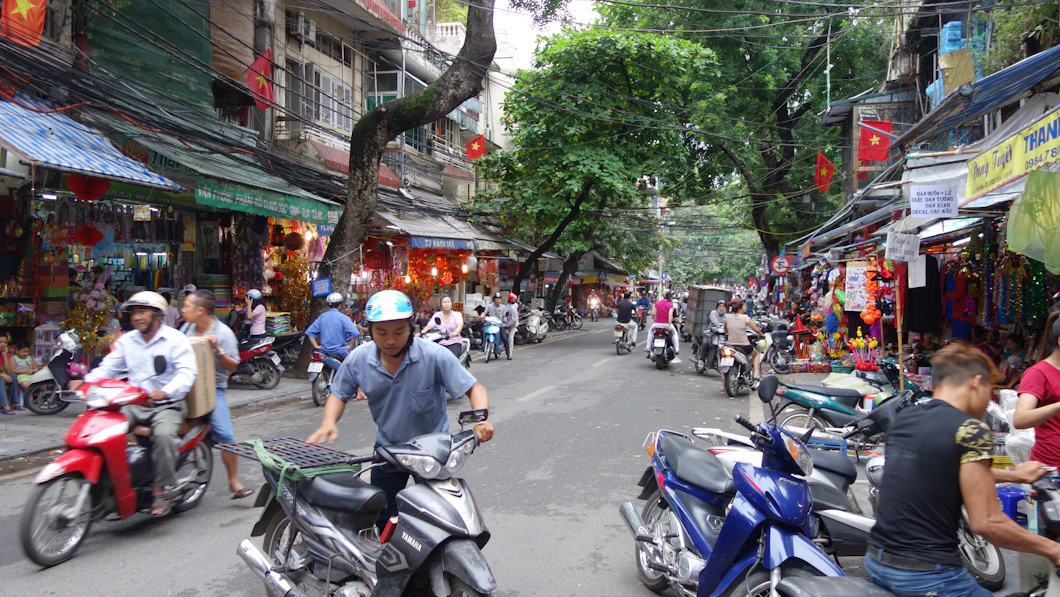
A semi-automatic rental motorbike in Hanoi gives an experienced rider flexibility, but it also brings responsibilities that a taxi, metro train or ride-hailing trip does not. You must handle the gears, protect yourself from the weather, find legal parking, comply with licensing rules and return the vehicle according to the agreement.
An automatic scooter removes gear changes but not those other obligations. The best choice depends on your actual journey, not on a blanket claim that motorbikes are the most authentic way to see the city.
This guide compares advantages, disadvantages and realistic alternatives. It deliberately does not repeat the price list: for rental charges, security deposits and the questions to ask about money, consult the Hanoi gear-bike rental rates guide. Nor is this a beginner riding lesson. If you cannot already control your chosen motorcycle confidently, consider transport that does not require you to ride it yourself.
1. First, understand what the rental company means by a “manual bike”
Table of contents25
Vietnamese rental terminology can be confusing. The term xe số often refers to an underbone commuter motorcycle such as a Honda Wave, typically fitted with a foot-operated gearbox and semi-automatic clutch. This is not necessarily the same as a conventional motorcycle with a hand clutch lever. An automatic scooter is different again: the rider does not select gears manually. A listing translated as “manual motorbike” may therefore describe a semi-automatic commuter bike rather than a full manual motorcycle.
Ask for the model, engine capacity, a photograph of the actual controls and a demonstration before accepting the keys. The choice should be based on the machine in front of you, its maintenance, brake condition, tyres and how well it fits your body. It would be misleading to compare an entire transmission category without considering the condition of the individual vehicle.
2. Advantage: more freedom across a multi-stop day
A rental bike can be useful when your day involves a sequence of journeys rather than just one trip out and back. You may need to visit colleagues, move between several neighbourhoods or change your plans at short notice. Having the vehicle available means you do not have to book a fresh ride for every leg. If destinations have legal motorcycle parking, a familiar bike can make that itinerary straightforward.
But independence has a cost in time and attention. You still need to navigate one-way streets, stop lawfully, secure the bike and retrieve it later. If every destination is in a crowded area with awkward parking, the supposed freedom may turn into a series of small chores. Judge the benefit by the complete door-to-door experience, including the time spent parking.
3. Advantage: a compact everyday machine for light travel
Many underbone motorcycles are built around daily commuting. Their relatively compact dimensions can make them manageable for someone who already rides a similar model. A solo rider carrying a small backpack may find a basic semi-automatic perfectly adequate for trips around town. The ability to park in an appropriate motorcycle area can also be useful where larger vehicles are impractical.
Compact size is not permission to squeeze through dangerous gaps, ride on footpaths or ignore traffic controls. A motorcycle remains a motor vehicle, with responsibilities to pedestrians and other road users. When evaluating a rental, prioritize predictable handling, good tyres and functioning lights over the promise that it will “fit anywhere”.
4. Advantage: familiarity may be more valuable than extra features
A rider who commutes on a Honda Wave at home may prefer a comparable machine in Hanoi. Gear changes, starting behaviour and road feel are already part of their routine. They can concentrate on signs and navigation rather than learning an unfamiliar transmission. For an extended stay, this familiar control scheme can be a meaningful practical benefit.
Do not assume all semi-automatic models feel identical. Seat height, gearing, brake response and tyre grip vary, especially in rental fleets that include older and newer vehicles. Even an experienced rider should inspect the bike and take a short, controlled trial where it is safe to do so. Habit reduces the learning burden; it never replaces a safety check.
5. Disadvantage: gear changes add work in stop-start traffic
In slow-moving traffic, the rider may have to change up or down frequently. Someone familiar with a semi-automatic generally manages this without much thought. For someone who has only ridden automatic scooters, however, selecting the right gear while turning, braking and watching traffic can be distracting. This is especially relevant at junctions, on gradients and when vehicles around you behave unpredictably.
A holiday should not begin with learning basic vehicle controls on a busy Hanoi road. If you are uncertain about starting, selecting neutral, downshifting or coming to a stable stop, do not rent that bike for public-road practice. Choose a transmission you already know, seek appropriate instruction away from traffic, or use a non-driving alternative.
6. Disadvantage: carrying bags is often awkward
A small underbone may have limited built-in storage compared with some automatic scooters. A lightweight bag can be manageable, but a suitcase or bulky camera kit is a different matter. Hanging heavy items from the handlebars can interfere with steering and braking. Improvised straps can loosen or catch on moving parts. Ask the operator about the model’s permitted load and approved luggage arrangements.
For airport transfers or hotel changes, a taxi with room for bags is often the more useful tool. You could move the luggage first and then rent a motorcycle for days when you are travelling light. Separating those jobs is usually a better solution than forcing a commuter vehicle to carry a suitcase it was never designed to transport.
7. Disadvantage: exposure, fatigue and weather
A motorcycle offers little protection from sun, rain or dirty spray from the road. This affects comfort as well as safety, particularly when visibility drops or the surface becomes slippery. Worn tyres, uncertain brakes and loose rainwear should all be treated as serious warning signs. Wear a properly fitting helmet, practical footwear and rain protection that cannot reach moving parts.
The right transport choice can change during the same trip. A bike may work well on a dry morning, while a taxi becomes sensible when heavy rain starts. Equally, do not ride after drinking alcohol, when exhausted after a flight or when medication impairs concentration. Having already paid a rental fee is not a reason to ignore your condition.
8. Side-by-side comparison of Hanoi transport options
| Transport choice | Main advantage | Important limitation | Often suits |
|---|---|---|---|
| Semi-automatic rental | Control over repeated journeys; familiar to experienced riders | Foot gear changes, parking and weather | Skilled rider making several stops |
| Automatic scooter rental | No manual gear selection; some models offer storage | Still requires riding skills, licence and parking | Rider comfortable on scooters |
| Motorcycle ride-hailing | No need to operate the vehicle | Availability and fare depend on trip conditions | Short point-to-point travel with light bags |
| Taxi / car ride-hailing | Better for luggage and wet weather | Traffic and per-trip cost remain factors | Airport luggage, groups, formal appointments |
| Public bus | No self-driving; useful along matching routes | Timetables and transfers may add walking | Regular trips near bus stops |
| Metro | Predictable station-based travel on an operating line | Limited station coverage; first/last-mile travel | Journeys linked to active stations |
| Walking | No rental collection or parking | Range, heat and accessibility constraints | A compact Old Quarter itinerary |
These are qualitative trade-offs, not universal rankings. Check today’s routes, operating hours, service rules and quoted costs before committing to any one option.
9. Semi-automatic versus automatic scooter: compare the rider, not the label
The clearest difference is how the controls work. A scooter with automatic transmission generally reduces the need to coordinate foot gear changes. A semi-automatic underbone can feel reassuringly familiar to someone who regularly rides one. Neither advantage is meaningful without considering personal practice. Switching from an automatic scooter to a Wave simply because the latter seems cheaper may be a false economy if it increases stress and distraction.
Also inspect seat height, braking system, tyre condition, suspension, storage and the actual passenger capacity. Avoid broad claims such as “semi-automatics always use less fuel” or “automatic scooters are always safer”. Those outcomes depend on the model, engine, riding style, maintenance and journey. Test the exact machine rather than purchasing a stereotype.
10. When a ride-hailing service may be better
Consider a traveller who wants to visit a museum in the morning, a café after lunch and a restaurant in the evening. If these are the only journeys, renting a bike creates extra work: collecting it, locating parking, worrying about where it can be left and returning it. A few booked rides can remove those steps and leave more time for the actual visit.
In contrast, someone who travels across the city repeatedly for work might value having a vehicle immediately available. The useful comparison is total waiting, walking, parking and riding time over a typical day. Use the route you will really travel, not the number of places you hope to see in a single ambitious itinerary.
11. When a taxi is worth the additional expense
Cars are useful when transporting multiple pieces of luggage, travelling with several people or trying to arrive at a meeting without dealing with rain and road dust directly. They do not eliminate congestion, but they change who is responsible for operating the vehicle and can offer more appropriate storage. For people arriving after a long flight, not having to ride unfamiliar roads is a significant advantage.
A sensible trip can mix vehicles: take a taxi from the airport, walk for local sightseeing, use public transport where it connects and hire a bike on suitable days. There is no need to commit to one method for an entire visit. The aim is a workable journey, not loyalty to a particular type of transport.
12. Buses and metro: consider the actual network
Hanoi has operating urban rail services, with station and route information provided by the official Hanoi Metro website. A journey that starts and ends near a served corridor may be easier without a rental bike. A bus or short walk can help with the part of the trip between the station and the final address, provided that the connection is practical.
Do not assume that a metro line directly reaches every attraction in the Old Quarter or every accommodation address. The first and last parts of a trip matter as much as the train ride. Before setting off, check official route maps, service times, ticket information and accessibility. Bus routes likewise need to be verified for the specific stop and day.
13. The Old Quarter is not always best explored on wheels
Many visitors stay close to Hoan Kiem Lake and plan to explore an area filled with small streets and nearby attractions. Walking may make more sense when the next café or shop is only a short distance away. A rental motorcycle can become an inconvenience if it has to be parked for every stop, especially where one-way systems and temporary pedestrian restrictions apply.
Walking is not the right answer for everyone or every season. Heat, heavy rain, mobility limitations and widely spaced destinations may call for short vehicle trips. Look at the map, identify clusters of places and plan each cluster as a unit. You may discover that you only need a vehicle for a portion of the day.
14. One rider and two riders are different journeys
A solo rider with light luggage places different demands on a commuter motorcycle from a pair riding for several hours. A passenger affects weight distribution, braking, low-speed stability and comfort. Confirm the manufacturer’s load limit, passenger footrests, seat design and any restrictions on the actual rental. Both occupants need properly fitted helmets and a safe seating arrangement.
A quick trip that feels comfortable does not prove that a long day will be enjoyable. Consider rest breaks and whether the machine remains easy to handle at low speed with both people aboard. If you also have bags, a different vehicle may serve the trip better. This is a practical limitation rather than a fault of semi-automatic transmission itself.
15. Compare total trip costs, not just daily rental fees
The displayed daily rate is only part of the decision. Allow for fuel, legal parking, any delivery and return fees, rain-day alternatives, the time required for the handover and the conditions covering damage or late return. A refundable security deposit is not the same as a rental charge, but it still affects how much cash or credit you must have available during the hire.
For a single short day, collection and return time may dominate the experience. For an extended stay, recurring journeys and parking become more important. The separate pricing and deposit guide explains the financial questions, while this article focuses on the comparison. Get the exact quotation and conditions in writing.
16. Licensing and legality come before preferences
Vietnam’s Road Traffic Order and Safety Law, Law No. 36/2024/QH15, came into force on 1 January 2025. Under the newer classification, an A1 licence generally covers two-wheeled motorcycles up to 125 cc or certain electric motorcycles up to 11 kW; licences issued under earlier rules have transitional provisions. See the official published law and government explanation of licence classes.
Visitors from abroad must check whether their national motorcycle entitlement, any relevant international driving permit and the recognition rules apply to the exact motorcycle. A car licence does not automatically permit motorcycle riding. An operator’s willingness to rent a machine cannot replace legal permission to drive it. If your documents are not valid, choose public transport, a taxi or a legitimate ride-hailing service instead.
17. Four travel scenarios to test the choice
A month-long commuter. An experienced underbone rider stays in Hanoi for several weeks, carries only a work bag and has legal parking at both ends of the journey. A well-maintained semi-automatic rental may be an effective tool; its value comes from repeated use and familiarity.
A weekend visitor staying in the Old Quarter. Attractions are clustered near the hotel and the visitor has never changed gears on a motorcycle. Walking and a handful of booked journeys are usually more coherent than learning a new machine in traffic.
A traveller changing hotels. There is a suitcase, a laptop and a late check-in. A taxi can handle the luggage and arrival, after which the traveller may consider a light motorcycle for later local trips.
A couple planning long distances. They want to travel together for hours and carry extra bags. Passenger comfort, load limits, the rider’s experience and weather plans matter more than a cheap daily rate; a car may be the better solution for some legs.
18. Ten questions to answer before booking
- Do I hold a valid licence for the precise motorcycle category?
- Have I recently used this gearbox, or am I relying on a vague memory?
- How many separate journeys will I actually make each day?
- Is legal motorcycle parking available at each important stop?
- Can the luggage be carried without affecting control or visibility?
- Will I carry a passenger, and is the vehicle suitable for both of us?
- What will I do in heavy rain or when too tired to ride?
- Are rental charges, deposits and handover times clearly documented?
- What support is available if the vehicle develops a problem?
- Would walking, rail, bus or ride-hailing make any leg simpler?
If several answers are uncertain, change the plan before making a commitment. You can still enjoy Hanoi without using a rental motorcycle for every journey.
Frequently asked questions
Is a semi-automatic motorbike always cheaper than a scooter?
No. Prices depend on the particular model, hire length and provider. The comparison should include parking, fuel, deposits and, above all, whether you can operate the motorcycle safely.
Is a Honda Wave the same as a manual-clutch motorcycle?
Not necessarily. Many Wave-style commuter models have foot-operated gears and a semi-automatic clutch. Ask which transmission is fitted to the specific rental.
Do I need a motorcycle for sightseeing in the Old Quarter?
Not necessarily. Walking and occasional booked transport may be simpler for nearby attractions. Check current signs and access restrictions rather than assuming every street is open to vehicles.
Can the metro replace a rental motorcycle?
For some trips that connect conveniently with operating stations, yes. Always consider the first and last mile, service schedule and actual destination.
Should I rent a small bike for two people and suitcases?
Only after checking the vehicle’s permitted load and practical comfort. Large luggage should generally be moved separately rather than improvised onto a small commuter bike.
Final verdict
A semi-automatic rental motorbike is valuable when the rider already knows the controls and needs flexible travel across multiple stops. It becomes less persuasive when luggage, weather, parking, unfamiliar gears or a compact sightseeing plan take priority. Choose the best mix of transport for each leg rather than assuming one motorcycle should do everything.
Editorial fact-check sources: Vietnam Road Traffic Order and Safety Law, official licensing overview and Hanoi Metro. Check current transport operations and legal conditions before your trip.
Before you choose, check condition, fit and luggage for rental motorbikes.

Comments